Product Core Architecture
A deep structural breakdown of our live Physical Chemistry Engine currently optimized for standard mobile environments.
High-Definition Mobile Interface Capture
Captured directly on iPhone 16 Pro Max resolution. Optimized for responsive deployment across Android APK and iOS production targets.
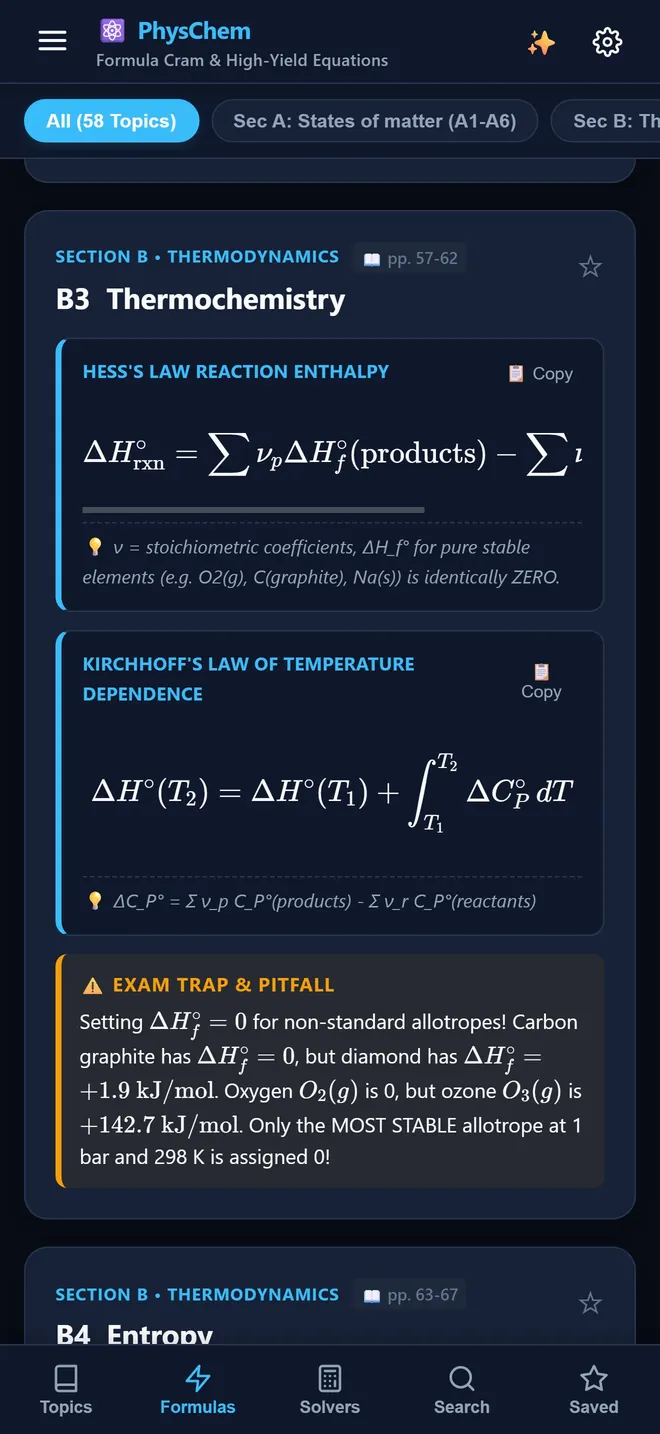
Thermochemistry & Pitfalls
Section B: Hess's Law, Kirchhoff's temperature dependence, and negative allotrope traps.
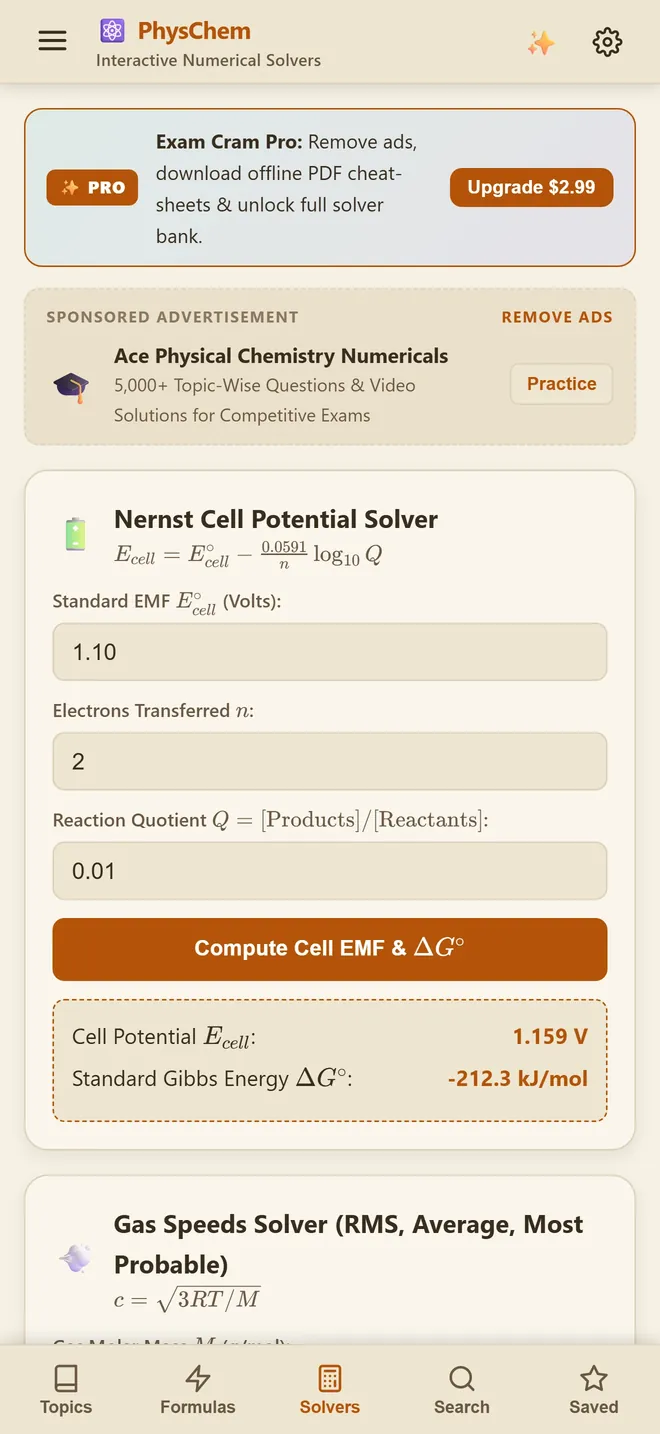
Nernst Potential Calculator
Interactive numerical solver computing cell EMF ($E_{cell}$) and $\Delta G^\circ$ without leaving notes.
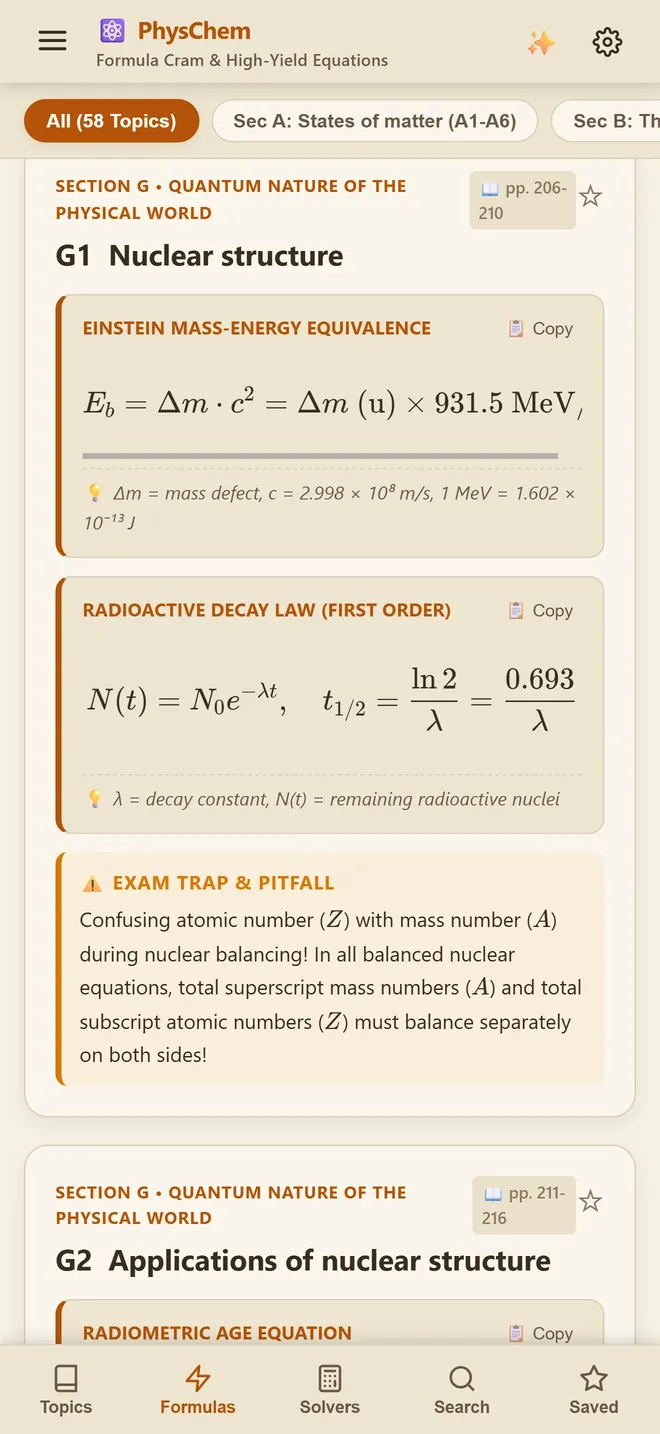
Quantum Nature & Decay
Section G: Einstein mass-energy, radioactive decay, and nuclear balancing traps.
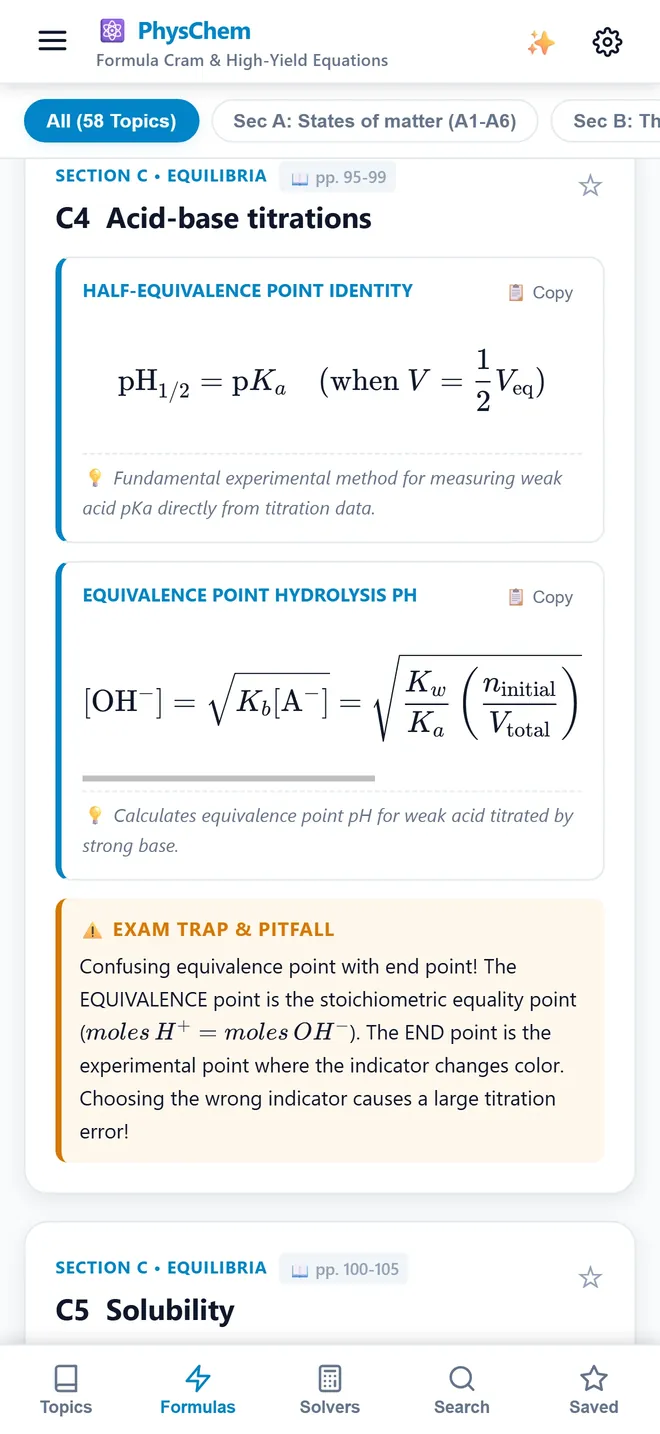
Acid-Base Titrations
Section C: Half-equivalence identity, salt hydrolysis pH equations, and indicator traps.
Featured Production Asset Showcase: Physical Chemistry Reference Library
Our premier framework systematically simplifies equations across core competitive fields. Rather than offering basic digital text dumps, the application isolates core thematic tracks:
Chemical Kinetics Pipeline
Clear derivation pathways mapping half-life calculations, activation parameters, and concentration matrices for multi-tier isolation processes.
Differential and integrated rate laws from Zero to 2nd Order. Explicit derivations of unit dimensions for rate constants: $[M]^{1-n} \cdot s^{-1}$.
Step-by-step substitution matrices proving concentration independence for First Order ($t_{1/2} = \frac{0.693}{k}$) vs. inverse dependency in Second Order.
Eyring transition state formulation and Arrhenius frequency factors with temperature-boundary checks, energy profile plots, and catalyst delta shifts.
Thermodynamic Milestone Mapping
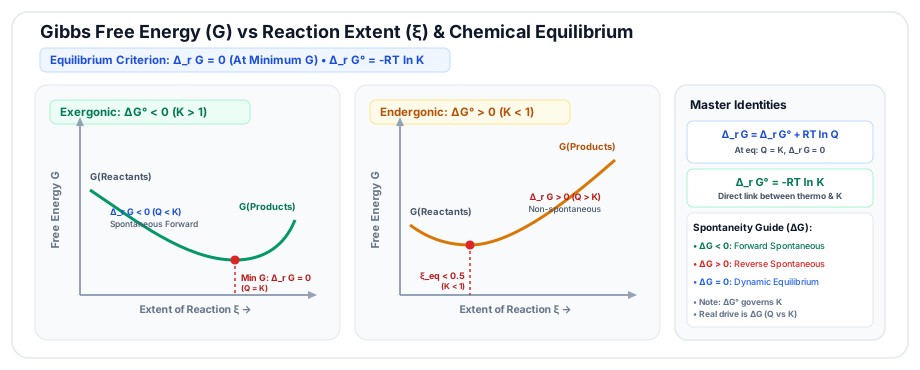
Instant reference points outlining entropy variations, Gibbs Free Energy equations, and state function boundary rules.
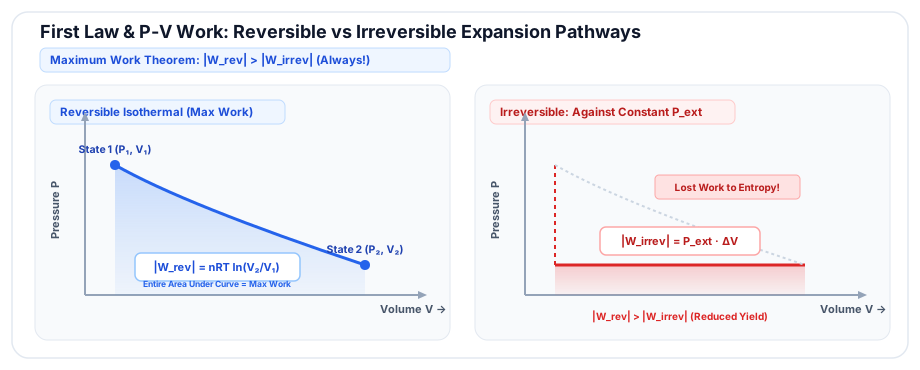
Exact mathematical distinction between path functions ($q, w$) and state properties ($U, H$). Isothermal reversible expansion integral proofs.
Clausius inequality derivations across isobaric, isochoric, and phase transition thresholds. Total universe entropy criteria for irreversible processes.
Coupled equilibria equations, temperature dependence of equilibrium constants, and fundamental Maxwell relations mapped for instant mobile lookup.
Electrochemistry Matrix
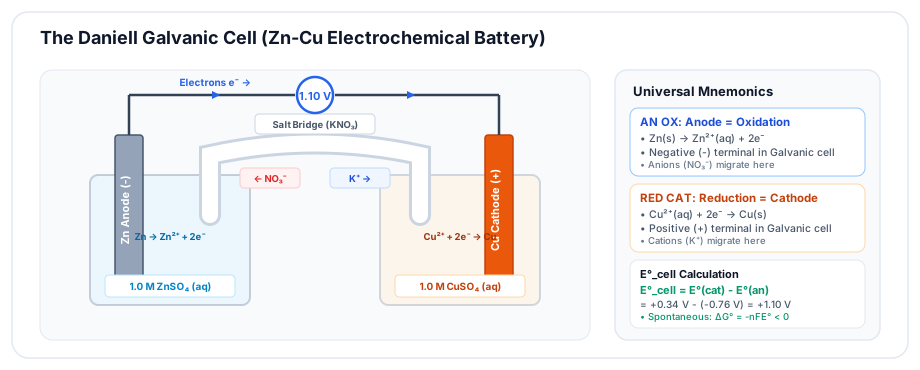
Linear configurations for Nernst equation deployments, conductance values, and electrolytic calculation steps.
Concentration cells, partial pressures in gas electrodes, pH calculation from hydrogen half-cells, and non-ideality activity coefficient calibrations.
Molar conductivity ($\Lambda_m$), cell constant calibration ($G^* = \kappa \cdot R$), and Kohlrausch's law of independent ion migration at infinite dilution.
Quantitative electrolysis equations, current efficiency ratios, deposition mass matrices, and stoichiometric electron balance for multi-valent cations.
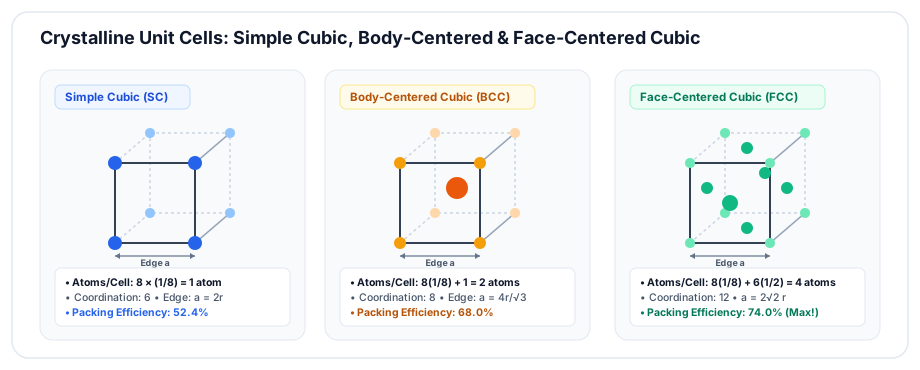
Solid State & Crystal Unit Cells
Atomic coordinate geometries, coordination numbers, packing fractions (52.4%, 68.0%, 74.0%), and Bragg diffraction planes mapped for competitive physics & chemistry exams.